




















It began with bones.
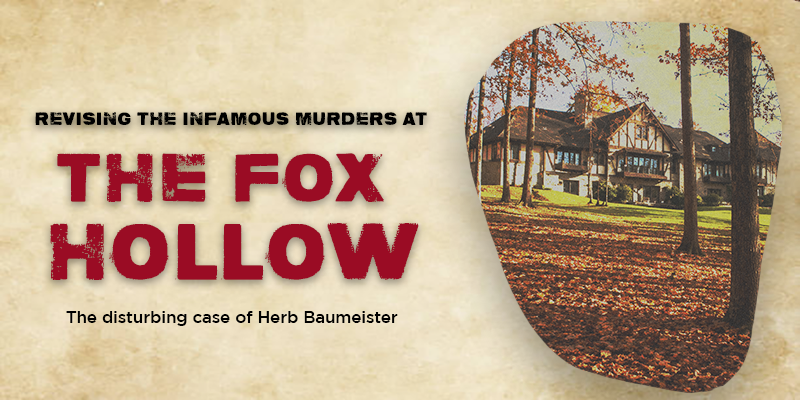
In June 1996, investigators entered the wooded acreage behind Fox Hollow Farm, an 18-acre estate outside Westfield, Indiana, and began finding human remains. Teeth and fragments of bone appeared among the leaves and soil, followed by thousands more pieces scattered through different sections of the property. Many had been burned, crushed or broken badly enough to complicate identification. What initially looked like an isolated discovery eventually became one of the largest forensic recovery efforts in Indiana history, exposing evidence that had been lying behind a family home for years.
The property belonged to Herbert Richard Baumeister, a married father of three who had built a successful thrift-store business with his wife, Julie. From the outside, his life contained many of the markers of conventional success: a large home, children, a growing business and enough money, at least for a time, to purchase a secluded estate with an indoor swimming pool and acres of wooded land. Investigators would eventually come to believe that the same privacy that made Fox Hollow an attractive family property also made it useful for concealing murder. Several men who had disappeared from Indianapolis’ gay community would later be identified among the remains recovered there.
Baumeister would never stand trial. Before investigators could arrest and question him about the discoveries on his property, he fled Indiana and died by suicide in Canada on July 3, 1996. He left no confession explaining the remains, no list of victims and no reliable account of when the killings began or how many people he murdered. Much of what became known afterward had to be reconstructed from physical evidence, missing-person investigations, survivor testimony, family recollections and thousands of bone fragments that forensic teams are still working to identify decades later.
The Troubling Childhood of Baumeister
Herbert Richard Baumeister was born in Indianapolis on April 7, 1947, the oldest of four children in a financially comfortable family. His father, Dr. Herbert E. Baumeister, was an anesthesiologist, while his mother, Elizabeth, managed the household. Nothing in the basic circumstances of his early childhood appears particularly remarkable, and it would be misleading to search his infancy for some obvious explanation of what investigators later found at Fox Hollow. The more unusual accounts begin during adolescence, when Baumeister reportedly developed behaviors that alarmed teachers, classmates, and eventually his own family.
Former classmates and later biographical accounts described an adolescent preoccupation with subjects that others found disturbing, including human urine and dead animals. At North Central High School, he reportedly placed a dead crow on a teacher’s desk and, on another occasion, urinated on a teacher’s desk in front of classmates. The incidents have become staples of nearly every retelling of Baumeister’s childhood, often presented as though they were unmistakable early signs of a future serial killer. They are better understood for what they actually demonstrate: his behavior was unusual and disruptive enough that adults around him became concerned.
That concern eventually led Baumeister’s father to arrange a psychiatric evaluation. Later accounts state that he was diagnosed with paranoid schizophrenia and antisocial personality disorder, although the underlying medical records are not publicly available and the diagnoses should therefore be treated with some caution. There is also little reliable documentation showing what treatment followed or how sustained it was. What appears consistent across accounts is that Baumeister received some form of psychiatric attention during adolescence but did not remain in a clearly documented long-term treatment program.
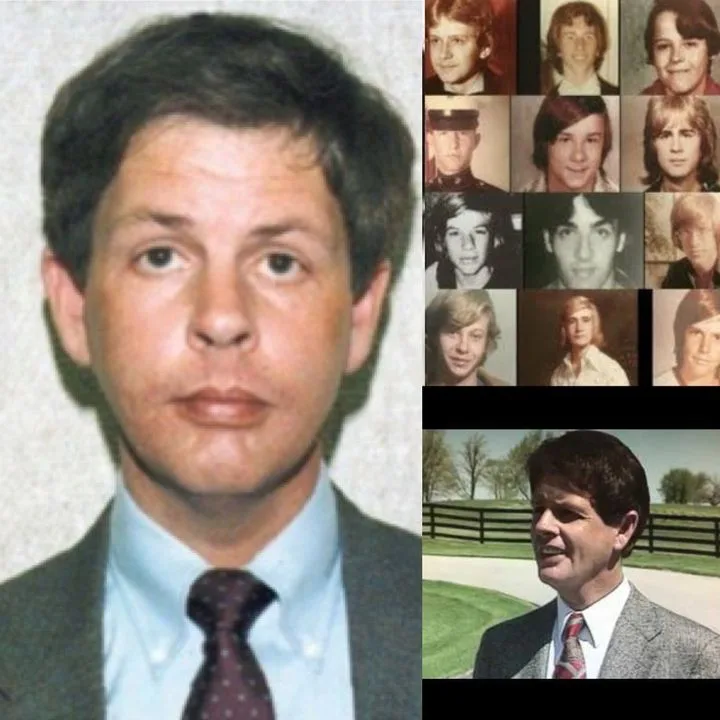
Image of Herb Baumeister and his victims
It would be tempting to turn this period into a tidy explanation for everything that followed, but doing so would create certainty where none exists. Mental illness does not predict serial murder, and unusual adolescent behavior is not evidence that later violence was inevitable. The popular tendency to revisit a killer’s childhood and arrange every strange incident into a sequence of “warning signs” often says more about hindsight than it does about the person at the time. Baumeister’s reported fascination with dead animals, his disruptive behavior and his psychiatric evaluation were unquestionably troubling, but millions of people experience psychiatric disorders or behavioral problems without becoming violent.
The more important question is what happened afterward. Baumeister learned, at least to some extent, how to function within ordinary social expectations. His behavior improved enough for him to remain in school, and he graduated from North Central High School in 1965. The boy remembered for bizarre classroom incidents did not immediately become an obvious criminal or social outcast living beyond the margins of respectable society. Over the following decades, he would attend university, marry, have children, hold government jobs, and eventually build a business successful enough to purchase Fox Hollow Farm.
That ability to construct an outwardly ordinary life would become far more significant than any dead crow left on a school desk. Whatever difficulties existed beneath the surface, Baumeister became capable of moving through institutions, employment, and family life without attracting suspicion of serious violence. By the time investigators entered the woods behind his home in 1996, the question was no longer whether his teenage behavior had somehow predicted what he would become. It was how a man with a wife, children, employees and a recognizable place in the community had managed to keep an entirely different part of his life hidden long enough for thousands of human remains to accumulate on his property.
Troubles Continue to Rise for Baumeister
For a time, Baumeister appeared to settle down. Whatever had prompted concern during his adolescence became less visible, and he graduated from North Central High School in 1965. That improvement should not necessarily be read as evidence that the underlying problems had disappeared. Much of what is known about his teenage behavior comes from recollections collected years later, after his name had become associated with murder, which makes it difficult to know how isolated or socially rejected he actually was at the time. Later accounts describe him as increasingly withdrawn and remembered for his disturbing classroom behavior, but the temptation to read every adolescent eccentricity as an obvious prelude to serial murder should be resisted.
This is one of the more difficult parts of Baumeister’s early life to interpret. Retrospective accounts often try to place him into a familiar true-crime framework built around childhood warning signs, mental illness and the assumption that later violence was somehow visible all along. That is rarely so simple. Baumeister had reportedly undergone psychiatric evaluation as a teenager, and his behavior had been serious enough to alarm both teachers and his family, but there is little public evidence showing what sustained treatment, if any, followed. It is reasonable to say that he was a troubled young man whose difficulties were not fully resolved. It is much harder to claim that those difficulties made his later crimes inevitable.
The distinction matters because several popular ideas about the childhood development of serial killers have been overstated for decades. Bed-wetting, cruelty to animals and fire-setting were once grouped into the so-called Macdonald triad and repeatedly cited as predictors of later homicidal violence. Modern research has not supported the idea that these behaviors form a reliable diagnostic pathway to serial murder. Baumeister’s reported fascination with urine, dead animals and disruptive behavior may tell us something about his adolescence, but they should not be treated as a checklist that explains what he would later become.
After high school, he struggled to establish a clear direction. Baumeister enrolled at Indiana University in 1965 but left after a single semester. He returned in 1967, again without completing a degree, and later attempted classes at Butler University in 1972 with much the same result. His educational history was fragmented, marked by repeated starts and abrupt departures rather than sustained progress toward a profession. It was during one of his periods at Indiana University that he met Juliana Sater, usually known as Julie, a former high school journalism teacher who would become his wife.
The couple married in November 1971, when Baumeister was 24. They had met through university circles and reportedly shared an interest in conservative politics, including involvement with the Young Republicans. To Julie and others who knew him socially, Baumeister could appear eccentric without seeming dangerous. The disturbing incidents from his adolescence were not necessarily common knowledge, and in an era before searchable records and social media, a person could leave behind an embarrassing or troubled reputation far more easily than they could today. Whatever classmates may have remembered about him, those memories did not follow Baumeister publicly into every new stage of his life.
Marriage did not bring immediate stability. Within months, Baumeister’s mental health deteriorated badly enough that his father arranged for him to be hospitalized in 1972. Julie later described him as deeply troubled during this period and said that he needed help. Accounts of the hospitalization generally state that it lasted roughly two months, after which Baumeister was able to return to ordinary life. Unlike the uncertain treatment following his teenage evaluation, this episode appears to have involved a more substantial psychiatric intervention, although surviving public accounts still provide relatively little detail about his diagnosis, treatment or condition after discharge.
He and Julie went on to have three children and eventually built the appearance of a conventional suburban family. Baumeister, however, continued to have difficulty settling into a stable career. His pattern of abandoning university courses was followed by a similarly uneven employment history. He could function well enough to hold respectable positions and make a favorable impression when necessary, yet accounts from people who knew him repeatedly describe abrupt shifts in behavior, unusual habits and an ability to alienate colleagues. These traits would become more apparent as he moved through a succession of jobs during the 1970s and 1980s.
It would be easy, knowing what was later discovered at Fox Hollow Farm, to interpret every failed semester, psychiatric episode or social difficulty as evidence of the man Baumeister would become. That would give the past a clarity it did not have at the time. In the early 1970s, he was not known as a predator or suspected killer. He was a young husband with an unstable educational record, documented mental-health difficulties and an inconsistent ability to function within ordinary institutions. The more disturbing pattern would emerge gradually, not through a single dramatic transformation, but through the widening gap between the respectable life he constructed and the increasingly troubling behavior visible to those who encountered him closely.
Baumeister moves into Fox Hollow Farm
By the early 1990s, the life Herb Baumeister had constructed looked considerably more successful from the outside than it actually was. Sav-A-Lot, the thrift business he had started in the late 1980s, initially prospered enough for the family to move in 1991 to Fox Hollow Farm, an 18-acre property near Westfield, north of Indianapolis. The large Tudor-style house, indoor swimming pool and wooded acreage suggested that Baumeister had finally found the stability that had eluded him through years of abandoned university courses, erratic employment and psychiatric difficulties. He opened a second Sav-A-Lot location and, at least superficially, appeared to have made an unlikely transition into a successful businessman, husband and father. The success was real to a point, but it was already beginning to fracture.
The second store failed to reproduce the performance of the first. By the summer of 1993, employees were noticing increasingly long absences during the workday and abrupt changes in Baumeister’s behavior when he did appear. Financial pressure mounted as the company faced lawsuits over unpaid services and the business began deteriorating. The mansion and acreage therefore represented something slightly different from the straightforward success story they appeared to tell. Baumeister had expanded quickly, assuming the costs of a second store and an expensive property just as the financial foundation beneath both began weakening. The image of prosperity remained intact longer than the prosperity itself.
His marriage was unstable as well. In February 1991, shortly before the family moved to Fox Hollow, Baumeister left the family home and filed for divorce. He and Julie later reconciled and proceeded with the move, but whatever had driven them apart had not simply disappeared. Later accounts of their marriage describe an extraordinarily limited sexual relationship, although the precise details come largely from Julie’s recollections after Baumeister’s death and should be understood in that context. What is documented is that the marriage continued to deteriorate as his business problems intensified, eventually leading Julie to file for divorce again in January 1996.
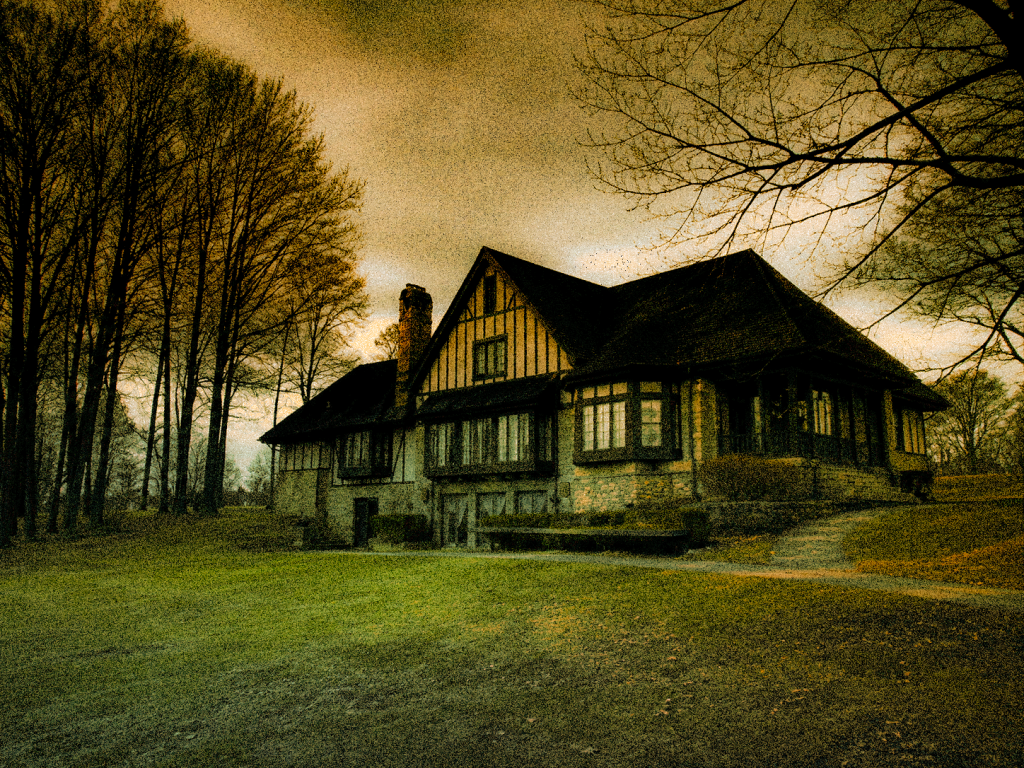
The house at Fox Hollow Farm (pictured from the back)
At the same time, Baumeister maintained a part of his life that his family apparently knew little about. He frequented gay bars and nightclubs in Indianapolis, and witnesses later associated him with the name “Brian Smart.” It is tempting to describe this simply as evidence of a double life, but that phrase can obscure an important distinction. A married man secretly seeking relationships or sexual encounters with other men is not, by itself, evidence of criminality, and homosexuality was not the sinister secret at the center of this case. The significant issue was what investigators came to believe Baumeister was doing within that concealed social world: approaching men, gaining their trust and bringing some of them to a secluded property from which they would never return. The secrecy surrounding his sexuality may have helped him compartmentalize different parts of his life, but it does not explain the violence attributed to him.
That compartmentalization nevertheless made him difficult to recognize as a threat. To his children, he could still be their father. To employees, he was an increasingly temperamental businessman whose company was struggling. To men he encountered in Indianapolis nightlife, he could present himself under another name altogether. Later investigative accounts describe a man calling himself Brian who met men in gay bars and invited them to a large, isolated house. One man who survived such an encounter told investigators that “Brian” took him to a residence with a swimming pool and attempted to strangle him with a pool hose during sexual activity involving asphyxiation. About a year later, the man was seen again, and a license plate eventually led police to Herb Baumeister. That identification would become one of the crucial breaks in the case.
The danger was emerging against a larger pattern that had already begun troubling Indianapolis’ gay community. By 1993, several young men who frequented local gay bars and nightclubs had disappeared. Their cases did not initially produce the sort of obvious crime scene that immediately establishes a serial pattern. There were no bodies grouped in one location and no known offender publicly connecting them. There were simply men who had gone out and failed to come home. The disappearances of Allen Wayne Broussard and Roger Allen Goodlet in 1994 drew greater attention, in part because relatives pushed for answers and hired private help. Investigators with the Marion County Sheriff’s Department and Indianapolis police were eventually looking at a cluster of missing men with similarities in age, appearance and social circles.
Connection between Braumeister and the I-70 Strangler
Determining when Baumeister began killing is considerably more difficult than many retellings suggest. The remains eventually recovered from Fox Hollow establish that multiple people died and were disposed of there, and several identified victims disappeared during the early to mid-1990s. Investigators later went further, however, and examined whether Baumeister might have been responsible for an earlier series of strangulation murders stretching back into the 1980s. Those deaths became associated with the unidentified offender commonly called the I-70 Strangler. Victims, many of them young men connected to Indianapolis’ gay nightlife, were found strangled and abandoned in rural locations, ditches, waterways and areas accessible from highways across Indiana and western Ohio. The series extended from 1980 into the beginning of the 1990s.
After the Fox Hollow investigation exposed Baumeister, detectives began comparing the two sets of cases. There were obvious similarities: male victims connected to the same general social scene, strangulation as a recurring method, and geographical overlap around central Indiana. Investigators also found circumstantial links placing Baumeister in western Ohio during the relevant period, and a witness in the 1983 killing of Michael Riley later identified Baumeister as resembling the man Riley had left with before his death. Perhaps the most intriguing coincidence was chronological. The highway-related killings ceased around the period when Baumeister moved his family to the secluded Fox Hollow property in 1991. Investigators theorized that an offender who previously needed to abandon bodies elsewhere would no longer need to do so once he controlled 18 private acres of wooded land.
It is a persuasive theory, but it remains a theory. Baumeister was never tried for the Fox Hollow deaths, much less the I-70 murders, and his death eliminated the possibility of interrogating him or testing the evidence through a criminal trial. Some investigators eventually concluded that he was responsible for the earlier killings, while the similarities between the cases have continued to fuel that belief. Even so, describing him simply as the proven I-70 Strangler goes further than the surviving evidence permits. The possibility matters because, if investigators were correct, Baumeister’s killings did not begin after the family arrived at Fox Hollow. The estate may instead have changed how he disposed of victims rather than when he began targeting them.
By the time men were disappearing from Indianapolis bars in 1993 and 1994, Baumeister had something an offender operating along highways would not have possessed: privacy. Fox Hollow sat on enough land for activity behind the house to remain largely invisible from neighboring properties. Investigators believe he approached men in Indianapolis, sometimes using the Brian Smart identity, and brought victims back while Julie and the children were away. Accounts of the pool area describe mannequins and unusual decorations, details that have since become some of the most repeated imagery associated with the case. More important than the decor, however, was the isolation. A visitor could be brought from a busy downtown bar to a large private residence miles away, with woods immediately beyond the house and few obvious witnesses to what occurred there.
The Fox Hollow Farm
The strangest feature of the pool room was the mannequins. Male figures stood around the indoor swimming area, some dressed and arranged as though they were guests at a gathering that never ended. It is impossible to know what Baumeister intended by placing them there, and later attempts to assign them some elaborate psychological purpose are largely speculation. They may simply have reflected the same eccentricity that people had noticed in him for years. Whatever their purpose, they made a strong impression on at least one man Baumeister brought home, whose account would eventually give investigators their clearest glimpse of what may have happened inside Fox Hollow Farm. A retired detective who later searched the house also remembered male mannequins positioned around the pool and described the room as immediately unsettling.
That surviving witness, identified in later accounts as Mark Goodyear, had encountered a man calling himself Brian Smart in Indianapolis’ gay nightlife. According to the account he later gave investigators, “Brian” invited him back to the secluded property to use the indoor pool. Goodyear was already suspicious of the unusual surroundings and reportedly avoided drinks Baumeister prepared for him. During the encounter, the conversation turned to erotic asphyxiation, a sexual practice involving the restriction of oxygen. At some point, Baumeister placed a hose around Goodyear’s neck and began tightening it. What may initially have been presented within the context of consensual sexual activity became something very different when Baumeister did not immediately stop. Goodyear survived the encounter and was eventually returned to Indianapolis.
His account is central to understanding the case because Baumeister never confessed and died before he could be questioned about the remains at Fox Hollow. No investigator witnessed one of the killings, and there was never a trial in which prosecutors could establish a complete method of operation. The popular reconstruction in which Baumeister routinely persuaded each victim to participate in erotic asphyxiation and then deliberately strangled him beside the swimming pool is therefore plausible, but not proven in every case. Investigators did have physical evidence supporting strangulation as a method in at least some deaths. During examination of the remains recovered from the property, several broken hyoid bones were found, injuries consistent with severe trauma to the neck. Combined with Goodyear’s account of being attacked with a hose, this gave investigators a strong basis for believing strangulation played an important role in the Fox Hollow killings.
What happened after the deaths is even harder to reconstruct. Fox Hollow gave Baumeister something extraordinarily useful to anyone attempting to conceal a crime: land and privacy. The estate covered approximately 18 acres, much of it wooded, allowing human remains to remain hidden surprisingly close to the family home. When investigators finally searched the property in June 1996, they found teeth and pieces of human bone scattered through the woods. The search expanded until thousands of fragments had been recovered, many so badly damaged that determining how many individuals were represented became an enormous forensic problem. Investigators ultimately collected roughly 10,000 bones and fragments, and later forensic work has shown that some had been burned and crushed.
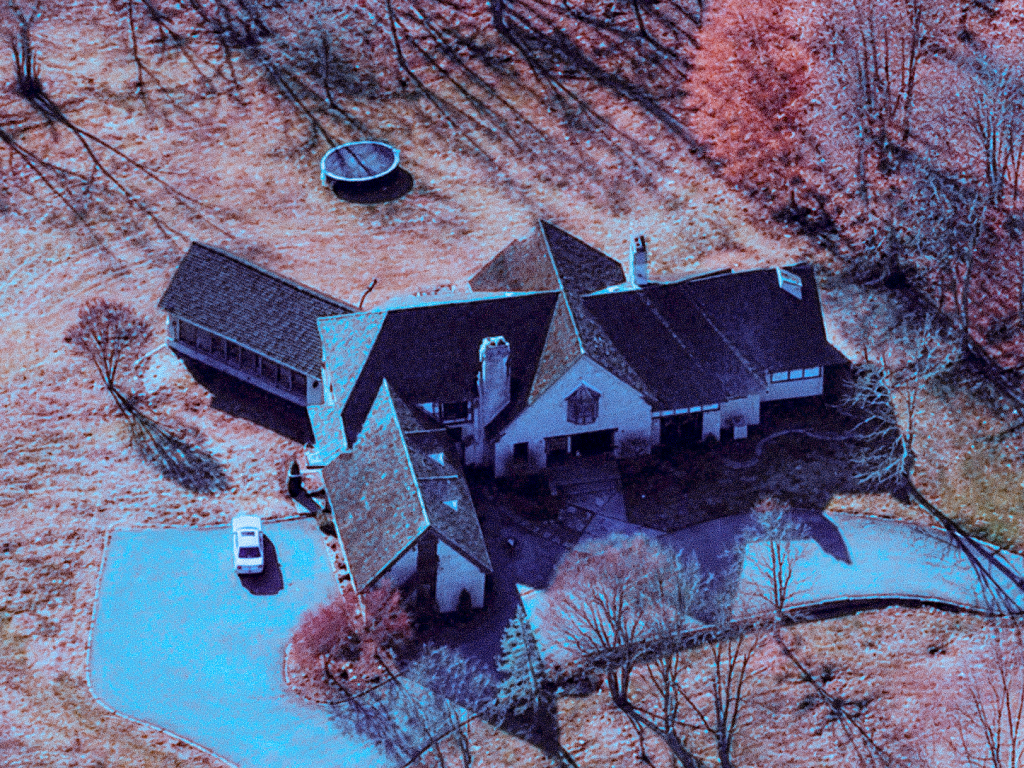
An areal shot of the fox hollow farm in early 2000s
Those findings are disturbing enough without embellishment. Some versions of the Baumeister story claim that he systematically dismembered victims, extracted their teeth with tools, and even tossed those teeth around his house as trophies. I could not find sufficiently strong contemporary or law-enforcement sourcing to treat that particular story as established fact. Teeth were unquestionably recovered from Fox Hollow, but their presence does not prove that Baumeister deliberately removed them. Likewise, the condition of the remains does not allow every broken bone to be attributed directly to him. Investigators believed bodies had been left exposed long enough for decomposition, animal activity and weather to scatter remains across portions of the property; one retired detective recalled intact bones washing into a creek after being displaced from higher ground.
There is stronger evidence that fire was used on at least some of the remains. Modern investigators attempting to identify the dead have repeatedly described the material recovered from Fox Hollow as burned, crushed and severely fragmented, damage that has complicated DNA extraction nearly three decades later. Whether burning was intended specifically to prevent identification, reduce the bodies for disposal, destroy evidence, or some combination of these purposes cannot be established because Baumeister left no explanation. What can be said is that the condition of the remains made the original investigation extraordinarily difficult and continues to obstruct efforts to return names to the dead. The damage was not merely a gruesome detail of the crime scene; it became one reason families would wait decades for answers.
Baumeister also appears to have benefited from the rhythms of his family life. Much of the case has traditionally been framed around periods when Julie and the children were away from Fox Hollow, giving him access to the house and property without close scrutiny. Later reporting and investigators have described him as bringing men to the estate while his family was absent, although claims that every known disappearance can be precisely matched to one of Julie’s trips are harder to verify from the surviving public record. The general arrangement nevertheless offered obvious opportunities. A man could be brought from Indianapolis to an isolated residence, remain unseen by Baumeister’s wife or children, and disappear into wooded acreage that few outsiders had any reason to search.
The disturbing part of Fox Hollow is not that Baumeister somehow transformed the house into the elaborate “murder playground” later documentaries sometimes suggest. It is how little transformation may have been necessary. The same swimming pool used by his family could host a stranger when they were gone. The same woods surrounding an expensive suburban home could conceal human remains. Daily family life and suspected murder did not require separate worlds; they occupied the same property, divided largely by timing and secrecy. For years, that separation held. The people closest to Baumeister saw fragments of his behavior, while the men disappearing from Indianapolis were being investigated elsewhere. It would take one man who survived the pool, and a discovery made by Baumeister’s own family in the woods, to finally bring those two worlds together.
The Growing Concerns for Investigation
From 1993 through 1995, men continued disappearing from Indianapolis with little outward evidence connecting one case to another. There were no bodies being recovered in a common location, no obvious crime scenes, and no publicly identified suspect tying the disappearances together. Several of the missing men were young, gay, and had connections to the city’s bars and nightlife, similarities that became increasingly difficult for people within that community to ignore. By 1994, families were pushing for answers while frustration grew over what some saw as an inadequate response from law enforcement. Former police detective Virgil Vandagriff, by then working as a private investigator, was eventually hired by the families of two missing men, Allen Wayne Broussard and Roger Allen Goodlet. When he began circulating missing-person posters and asking questions in gay bars, he later recalled discovering that the number of missing men was larger than he had initially understood.
Goodlet, 33, disappeared in July 1994, roughly six weeks after 28-year-old Broussard vanished that June. Their cases became particularly important because the private investigation surrounding them eventually produced information about a man using another name. One of Goodlet’s acquaintances told investigators about his own disturbing encounter with a stranger he had met in a gay bar. The man had taken him to an expensive suburban house with an indoor swimming pool and attempted to strangle him with a hose. The survivor did not initially know where the house was or the man’s real identity, but when he encountered him again, he helped obtain a vehicle license plate. That plate led investigators to Herbert Baumeister.
When the remains at Fox Hollow Farm were discovered in 1996, Goodlet and Broussard were among the men investigators worked to identify from an enormous collection of fragmented bone. Both would ultimately be associated with remains recovered from the property. Goodlet’s identification, originally made through dental evidence in 1996, was independently reinforced nearly three decades later when DNA testing by the University of North Texas Center for Human Identification confirmed the match.
Among the youngest was Johnny Bayer, 20, who disappeared on May 28, 1993. For years, his family had no reliable explanation for where he had gone. Eventually, a single rib recovered among the Fox Hollow remains was identified as his. The scale of that identification is difficult to separate from what it meant to his family: thousands of fragments had been removed from the property, yet what could be returned to Bayer’s mother was essentially one piece of her son. In a 1999 interview with the Indianapolis Star, Rose Dewey described how unreal his death still felt even after the DNA match and funeral, because so little of him had been recovered.
Richard Douglas Hamilton was also 20 when he disappeared on July 31, 1993. Public accounts provide fewer details about his final known movements than they do for Goodlet or Broussard, but his remains were among those ultimately identified from Fox Hollow. Steven S. Hale, 26, disappeared on April 1, 1994 and was likewise identified among the dead. Contemporary summaries of the investigation list both men among the eight victims whose remains had been identified by 1999, alongside Bayer, Broussard, Goodlet and several others. What cannot responsibly be said is that every one of these men was definitively murdered inside the house or beside the swimming pool. Their remains being found on Baumeister’s property establishes the connection to Fox Hollow, but Baumeister’s death before arrest meant prosecutors never had the opportunity to establish the circumstances of each killing in court.
Manuel Resendez disappeared in August 1993 after traveling from Lafayette to Indianapolis. His case illustrates how long the identification process has continued. Although his name appeared in some older summaries of suspected Fox Hollow victims, modern DNA work formally confirmed that remains recovered from the property belonged to him. For nearly three decades, Manuel Resendez remained one of the men whose fate was associated with Fox Hollow but never conclusively established through modern forensic testing. That changed in January 2024, when Hamilton County Coroner Jeff Jellison announced that remains recovered from the property in 1996 had been matched to Resendez through DNA from a family reference sample.
Resendez was 34 when he disappeared in August 1993. His identification was part of a renewed effort begun in 2022 to revisit thousands of burned and fragmented remains using techniques that simply had not existed when investigators first searched the property.
The emerging victim list eventually demonstrated why the disappearances had been so difficult to understand while they were happening. These were separate men vanishing on separate dates, sometimes from different cities, leaving families to pursue individual missing-person cases without knowing that investigators would later recover their remains from the same wooded property. Baumeister benefited from that fragmentation. No body appeared immediately after a disappearance to point investigators toward Westfield, and the thousands of burned and broken remains later recovered at Fox Hollow made identification extraordinarily difficult even after the suspected burial ground was known. The case was not solved because police suddenly recognized a perfect pattern in the missing-person files. It began to come apart because families kept asking questions, a private investigator started comparing cases, and one man who survived an encounter with Baumeister was eventually able to point investigators toward the person behind the name “Brian.”
The same renewed investigation soon produced another confirmation. Jeffrey Allen Jones, 31, disappeared from Indianapolis in July 1993 and had long been considered a probable Fox Hollow victim. In May 2024, forensic genetic genealogy conclusively connected previously unidentified remains from the property to Jones. His case demonstrated one of the peculiar difficulties surrounding Fox Hollow: some men had been suspected victims for years without investigators being able to determine which fragments belonged to them. By 2024, advances in DNA extraction were allowing forensic teams to revisit those assumptions rather than simply accepting identifications made under the limitations of 1990s technology.

An inside view of the swimming pool from the Fox Hollow Farm
Allen Livingston disappeared in August 1993. He was 27, and the last known account placed him getting into a car in downtown Indianapolis. When the bones at Fox Hollow Farm were discovered three years later, his family wondered almost immediately whether Allen might be among them. There was no way to know. His mother, Sharon, spent the next 27 years without an answer.
That answer finally came in 2023. After the Hamilton County Coroner’s Office reopened efforts to identify the remaining Fox Hollow remains, DNA testing confirmed that some of the bones belonged to Allen. Sharon was still alive when the identification was made. She died the following year.
The newer forensic work has also added a victim investigators did not even know to look for. Daniel Thomas Halloran had never been part of the original list of missing men associated with Baumeister. In fact, he had not been reported missing at all. His name emerged only after forensic genetic genealogy was used on unidentified remains from Fox Hollow. In April 2025, authorities confirmed his identity, making Halloran the tenth person positively identified from the property.
Other names remain far less certain. Jerry Williams-Comer disappeared on August 8, 1995, when he was 34. His vehicle was later found abandoned at Castleton Square Mall, and because of when and where he vanished, investigators have considered the possibility that he crossed paths with Baumeister. No remains belonging to Williams-Comer have been identified at Fox Hollow, however. His disappearance remains unresolved, and calling him a confirmed victim would go beyond the evidence.
The numbers surrounding Fox Hollow are similarly messy. Investigators recovered roughly 10,000 bones and fragments from the property, many of them burned, crushed, or too damaged to identify using the technology available in 1996. Early estimates suggested they could represent as many as 25 people. Ten have names so far. The rest are not a neat list of “unknown victims,” because investigators still do not know exactly how many individuals are represented among the remaining fragments.
That uncertainty is part of what made the case so difficult in the first place. Men were disappearing from Indianapolis, but there was no pile of bodies linking the cases together and no single crime scene pointing police toward one offender. Their families saw sons, brothers, and friends who had suddenly vanished. On paper, law enforcement saw separate missing-person files spread across different dates and, in some cases, different jurisdictions.
People within Indianapolis’ gay community had already begun to suspect that the disappearances were connected. Eventually, the families stopped waiting for someone else to make that connection for them. Their persistence brought former detective and private investigator Virgil Vandagriff into the case. Once he began comparing the missing men and asking questions in the bars they had frequented, the investigation finally started moving toward the man who called himself Brian.
The Fox Hollow discoveries confirmed what many families and members of Indianapolis’ gay community had feared for years: the disappearances were not isolated. By then, frustration had hardened into anger. Josh Thomas, a former publisher in the city’s gay press, argued in 1996 that the response would have been very different had the victims belonged to a more socially protected group. His comparison was blunt. If suburban high-school cheerleaders had been disappearing, he said, authorities would not have rested until someone was caught.
That criticism did not mean police had done nothing. Missing-person cases were being investigated, and detectives eventually worked with information developed by private investigator Virgil Vandagriff and a surviving witness. The problem was that the cases remained scattered for too long. Different men disappeared on different dates, some from different jurisdictions, and without bodies or a common crime scene there was little to force investigators to see one offender behind them. Prejudice and distrust made that harder. A missing gay man could too easily be treated as someone who had simply left town or cut ties, rather than someone who might have been in danger.
Baumeister benefited from that delay. He did not need every disappearance to be ignored. He only needed the cases to remain separate long enough for no one to connect them to Fox Hollow Farm.
Decades later, investigators are still trying to repair that gap. DNA work has identified Allen Livingston, Manuel Resendez, Jeffrey Jones, Daniel Halloran, and others whose remains sat unidentified for years after they were recovered in 1996. More fragments and DNA profiles remain unresolved. For some families, the person they spent years waiting for may already have been found at Fox Hollow. The only thing still missing is a name.
The Police Move in to find the Fox Hollow Killer
By 1994, the disappearances of gay men in and around Indianapolis were becoming difficult to dismiss as coincidence. The cases were scattered across multiple dates and jurisdictions, with no bodies or common crime scene to connect them. Families were left with missing-person reports, unanswered calls, and the growing suspicion that the men had not left on their own.
The investigation changed when Mark Goodyear (as mentioned in this article before), known publicly for years under the pseudonym Tony Harris, came forward with an account of a man he knew as “Brian,” sometimes identified as Brian Smart. Goodyear had met him through Indianapolis’ gay nightlife and gone with him to a large, secluded house with an indoor swimming pool. During a sexual encounter involving asphyxiation, Goodyear said Brian wrapped a pool hose around his neck and tightened it. Virgil Vandagriff later said Goodyear survived by pretending to lose consciousness, although accounts differ on some details of the encounter.
At first, that was not enough to identify the man. Goodyear had been driven to the property and did not know its address. He knew his attacker only as Brian. Roughly a year later, however, he encountered him again in an Indianapolis bar. Someone obtained the man’s license plate number, and when investigators traced it, the vehicle was registered to Herbert Baumeister of Westfield.
Baumeister owned Fox Hollow Farm, an 18-acre estate with an indoor swimming pool that matched Goodyear’s description. Investigators now had a real name, a specific property and a surviving witness who said he had nearly been strangled there. Baumeister also moved within the same social scene from which several men had disappeared.
Even then, police could not simply search the property. Baumeister denied involvement and refused permission. Julie Baumeister initially refused as well, unable to believe her husband could be connected to the missing men. Vandagriff later said authorities did not have enough evidence from Goodyear’s account alone to secure a search warrant.
By 1995, investigators therefore knew who “Brian” was and where the encounter had taken place, but they still could not search Fox Hollow. The case had finally narrowed from a scattered group of disappearances to one man and one property. What police did not yet know was that evidence had already been lying in the woods behind Baumeister’s home for years.
Baumeister’s psychiatric history added little of legitimate investigative value. Later retellings sometimes suggest that detectives discovered his earlier mental-health problems and found that they somehow matched the profile of a serial killer. That is hindsight masquerading as evidence. A history of psychiatric hospitalization does not establish homicidal behavior, and whatever diagnoses Baumeister may have received decades earlier could not provide probable cause to search his property. More relevant were the things investigators could actually connect to the case: Goodyear’s account, the alias, the license plate, Baumeister’s presence in Indianapolis gay bars and a property matching the survivor’s description.
With Baumeister refusing access, investigators turned to Julie. Her first reaction was disbelief. She later recalled police approaching her and saying they were investigating her husband in connection with what they described, in the terminology of the period, as “homosexual homicide.” Julie remembered asking what the phrase even meant before rejecting the accusation outright. “You’re wrong. That can’t be true,” she later recalled telling them. The language itself is revealing of the era in which the investigation unfolded. These were homicides in which the missing and suspected victims were gay men, yet the terminology reinforced the sense that they belonged to a separate category of crime, much as the disappearances themselves had often existed in separate investigative files rather than being immediately recognized as part of one pattern.
Julie’s disbelief was not particularly difficult to understand. She knew her marriage was troubled and her husband could be erratic, secretive and difficult, but investigators were asking her to accept something far beyond marital dysfunction. The allegation implied not only that Baumeister had maintained a hidden sexual life with men, but that some of those men might have disappeared after encountering him. Whatever suspicions Julie may have had about her husband’s behavior, murder required an entirely different mental leap. Rather than immediately opening the property to police, she initially refused permission, leaving investigators in essentially the same position they had occupied with Herb.

The main house of the Fox Hollow Farm from the entrance
For roughly five months during 1995, according to later reporting, investigators continued trying to persuade Julie to reconsider. The surviving witness had given them a direction, but no bodies had yet been connected to Baumeister, and no physical evidence from Fox Hollow could be examined without access to the property. Meanwhile, Baumeister knew police were interested in him. It is tempting to assume that this knowledge caused him to stop killing, and the known chronology does become thinner after 1995, but that conclusion cannot be proved. Michael Frederick Keirn disappeared in March 1995 and is among the identified Fox Hollow victims. Jerry Williams-Comer disappeared that August and has sometimes been listed as another possible Baumeister victim, although his remains have never been identified at Fox Hollow and his case remains unresolved. The absence of later confirmed victims may indicate that Baumeister became more cautious, stopped altogether, changed his methods, or simply left behind victims who have never been identified.
The stalemate began to weaken not because police finally produced a decisive new witness, but because Julie herself started reconsidering what she had been told. She later remembered asking herself a simple question: what if the police were right and she was wrong? That doubt mattered because there was something else about Fox Hollow that investigators did not yet know. Two years earlier, in 1994, one of the Baumeisters’ children had found what appeared to be a human skull in the woods behind the house. Herb had offered an explanation for it, and at the time Julie had accepted it. Once detectives began telling her that men were disappearing and that her husband had been linked to a survivor who described being strangled at their home, that old discovery became considerably harder to dismiss.
By the spring of 1996, the investigation had therefore reached an unusual position. Police suspected Baumeister, knew a survivor had been attacked at a property matching Fox Hollow, and had spent months seeking permission to search it, yet the strongest physical clue had already been found by Baumeister’s own family without anyone realizing what it represented. The question was no longer simply whether Julie believed the detectives. It was whether she was willing to let them return to the woods and determine exactly what her son had stumbled across
For months after investigators first approached her, Julie Baumeister refused to believe that her husband could be connected to the missing men. Her reaction is easy to criticize with the benefit of knowing what was eventually found at Fox Hollow, but she did not have that knowledge in 1995. What she had was a troubled marriage, a husband she knew could be controlling and erratic, and detectives asking her to consider the possibility that the father of her children had maintained a secret life involving men who had subsequently disappeared. She initially refused permission to search the property, reportedly following legal advice, even as investigators continued contacting her. Over time, however, the allegations began forcing her to reconsider incidents she had previously accepted or pushed aside.
One memory in particular became impossible to dismiss.
In December 1994, Baumeister’s teenage son and a friend had been exploring the woods behind Fox Hollow Farm when they found a human skull. According to Julie’s later interview with Hamilton County investigators, the boys took her to the location rather than carrying the skull back to the house. She saw it resting among the trees, along with additional bones nearby, and instructed them to leave everything where it was. Julie later described the scene as looking almost as though someone might have collapsed and died there. Herb was not home when the discovery was made.
When he returned, Julie confronted him. Baumeister supplied an explanation that was unusual but not completely implausible given his family background. His late father had been an anesthesiologist, and Herb claimed the bones belonged to an old medical teaching skeleton that his father had owned. According to Julie, he suggested that raccoons had somehow gotten into the area where the specimen had been stored and dragged portions of it into the woods. She later told detectives that Herb simply brushed the matter aside and identified the skeleton as his father’s. Her own recollection was more complicated than later retellings sometimes suggest: “I didn’t really believe it, but I didn’t know what to do,” she told investigators. Herb subsequently disposed of the skull and bones in the trash, and the incident receded without being reported to police.
That detail substantially changes the simplistic version in which Julie unquestioningly accepted an obviously absurd explanation. Her later statement suggests uncertainty rather than complete belief. At the time, however, she apparently had no reason to connect the bones to a series of missing men in Indianapolis. There was no public accusation tying her husband to multiple disappearances, and Fox Hollow had not yet been identified as a possible crime scene. Once detectives began approaching her in 1995 and describing the investigation into Herb, the skull acquired an entirely different significance.
It is sometimes claimed that the 1994 discovery frightened Baumeister into temporarily stopping his murders. The chronology does not support stating that confidently. Michael Frederick Keirn, whose remains were later identified among those recovered at Fox Hollow, disappeared on March 31, 1995, several months after the skull was found. Investigators may reasonably have wondered whether the discovery forced Baumeister to become more cautious, but there is no evidence establishing what effect it had on his behavior or whether he consciously suspended and resumed killing. What can be said is more disturbing in its simplicity: by the time the boys encountered the skull, investigators now believe the remains of several people were already scattered across the property.
Baumeister is Caught, and Commits Suicide
Meanwhile, the structure of Baumeister’s life was deteriorating. His Sav-A-Lot businesses were in financial difficulty, his marriage was collapsing, and Julie was moving toward divorce. In her later account of this period, she admitted that the family life she had regarded as stable increasingly looked different in retrospect. Investigators continued asking her to permit a search, but without her consent or enough evidence to persuade a judge to issue a warrant, they remained outside the property. Detective Mary Wilson had already examined Baumeister’s court records, business problems, divorce filings and employment history, visited Fox Hollow, and confirmed that it matched survivor Mark Goodyear’s description. Even with that work, she had been unable to obtain judicial authorization to search the estate.
The stalemate finally ended on June 24, 1996.
That day, Julie’s attorney, Bill Wending, contacted Detective Wilson and disclosed something investigators had not previously known: the Baumeisters’ son had found a skull on the property approximately two years earlier. Wilson and Hamilton County investigators met Julie at Fox Hollow while Herb was away. Julie, who was then seeking a divorce, led them into the woods and showed them where the skull had originally been discovered. They did not need to excavate deeply before the nature of the property began to change before them. During the short walk through the wooded area, investigators spotted additional bone fragments and human teeth. For the first time, they had physical evidence on Fox Hollow itself that could be connected to the missing-person investigation.
The legal sequence is important. Julie’s permission allowed investigators onto the property for that initial examination, but it did not simply become a blanket substitute for a search warrant. Once human remains and teeth were discovered, investigators took that evidence to a judge. By approximately 10 p.m. on June 24, a warrant had been signed authorizing a full search of Fox Hollow Farm. The following day, June 25, law-enforcement officers returned with forensic anthropologists from the University of Indianapolis and began the far slower process of systematically examining the 18-acre estate.
What began as a search around the spot where one skull had been seen quickly expanded. Investigators found human teeth and bones lying in and beneath the wooded ground. As forensic teams worked outward, they encountered more fragments, many burned and broken, spread through areas behind the house. The recovery would continue for weeks and, through the original search and later examinations of the property, eventually produce roughly 10,000 bones and fragments. Modern investigators estimate that the material could represent as many as 25 people, although the precise number remains unknown.

Another inside picture from the pool where he killed
Once the full search began, the scale of Fox Hollow Farm became increasingly difficult to comprehend. Investigators were not dealing with a conventional burial site containing intact graves. Human remains were scattered through the wooded acreage behind the house, sometimes exposed near the surface and sometimes mixed into the soil as small fragments. Search teams recovered teeth, charred pieces of bone, and larger skeletal remains from different areas of the property. Handcuffs and shotgun shells were also among the evidence recovered, although there is no established evidence that Baumeister shot the men whose remains were found there. Over the original excavation and subsequent searches, approximately 10,000 bones and fragments would eventually be collected, many burned, broken or crushed badly enough to make even determining how many people were represented an ongoing forensic problem. Investigators ultimately estimated that the remains could belong to as many as 25 individuals.
By the time forensic teams began systematically excavating the property on June 25, 1996, Baumeister was already gone. This is an important correction to the often-repeated version in which police uncovered the remains, issued an immediate murder warrant on June 29, and narrowly missed arresting him. Contemporary investigative summaries indicate that Baumeister had left Indiana before the digging fully exposed the extent of the site. Authorities continued assembling their case while attempting to locate him, and an arrest warrant was in investigators’ hands by July 3. By then, however, he had traveled north into Canada.
On July 3, 1996, Baumeister was found dead at Pinery Provincial Park on the Ontario shore of Lake Huron. He was 49 and had died from a self-inflicted gunshot wound. Investigators who later examined his vehicle found that it had been stripped unusually clean, with carpeting removed, raising additional questions about whether evidence had been deliberately destroyed before his death. Whatever answers Baumeister might have provided about Fox Hollow, the missing men or the earlier highway strangulations disappeared with him. He was never arrested, interrogated about the remains, charged with the Fox Hollow killings or placed before a jury.
He did leave a suicide note, but it offered investigators virtually nothing about the case. According to FBI records later reviewed in connection with the investigation, Baumeister wrote primarily about his failing marriage, collapsing business and what he imagined for his family’s future. Contemporary accounts also reported an oddly mundane apology concerning the effect his death would have on the park. What the note conspicuously lacked was any explanation for the human remains at Fox Hollow. There were no victim names, no confession and no account of how or why the men had died. An FBI summary concluded that the letter yielded no useful information about the bones or the identities of the dead.
Baumeister’s death therefore ended the possibility of prosecuting him, but it did not end the investigation. The immediate problem shifted from finding a suspect to identifying thousands of damaged human remains. Forensic anthropologists and investigators spent months sorting bones, comparing dental records and using the DNA technology available at the time. By the end of the 1990s, eight men had been identified from Fox Hollow. For their families, those identifications answered one question while creating others that Baumeister could no longer be forced to answer. They could finally know that their sons, brothers and friends had not voluntarily disappeared, but there would be no criminal trial establishing exactly when they died, what happened inside Fox Hollow or whether anyone else knew more than they had admitted.
For years, much of the remaining evidence sat in storage at the University of Indianapolis Human Identification Center. The original investigators believed the approximately 10,000 bones and fragments could represent at least 25 people, meaning a substantial number of possible victims remained without names. Advances in DNA analysis eventually made it possible to revisit evidence that had once been considered too damaged or incomplete to identify. When Hamilton County Coroner Jeff Jellison took office, his department renewed the effort in 2022, seeking DNA from relatives of men who had vanished in Indiana during the years Baumeister was active. Jellison later criticized the earlier decision to halt publicly funded DNA testing while unidentified remains were still awaiting examination, arguing that the unfinished work had effectively been left to families and future investigators.
The renewed investigation quickly demonstrated how much information was still recoverable. Cadaver dogs returned to the former Fox Hollow property in December 2022, and another bone was recovered during the search. More significantly, forensic genetic genealogy began attaching names to remains that had been stored for nearly three decades. Allen Livingston, who disappeared in 1993, was identified in October 2023. Manuel Resendez, also missing since 1993, was confirmed in January 2024 through a family DNA reference sample, and Jeffrey Allen Jones was conclusively identified later that year.
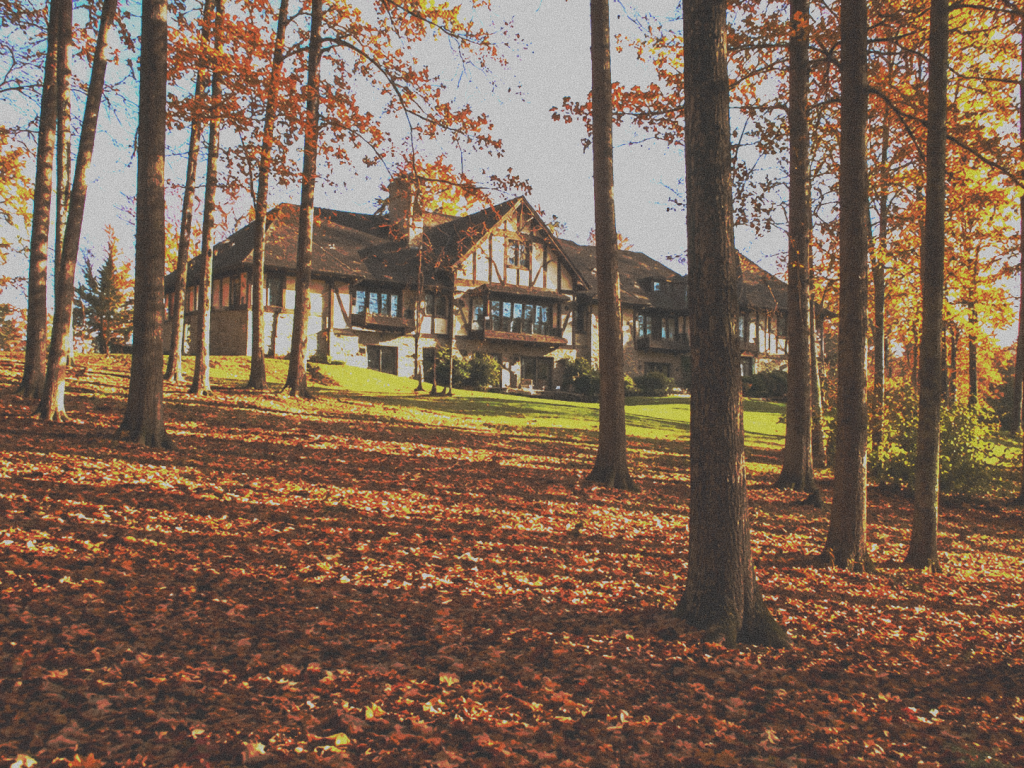
The grounds behind the house of Fox Hollow Farm where all the remains were found
In April 2025, investigators identified Daniel Thomas Halloran, a man who had not originally even been reported as a known Fox Hollow victim, bringing the number of positively identified people associated with the remains to ten.
Even that number does not describe the full state of the evidence. Investigators have developed additional DNA profiles from the remains, suggesting that more individuals are represented than those currently named. As recently as February 2026, the Hamilton County Coroner’s Office appealed publicly for help identifying a Fox Hollow DNA profile that produced no match in the national CODIS database. Nearly 30 years after the first excavation, the investigation is therefore still producing information that could connect an unidentified fragment to a person whose family may have spent decades without knowing what happened.
The Fox Hollow case is often reduced to Herb Baumeister: the wealthy estate, the mannequins around the pool, the secret trips to Indianapolis bars and the thousands of bones behind his house. That version risks giving the killer more narrative space than the people whose disappearances made the investigation necessary in the first place. The case moved forward because families refused to accept that their missing sons had simply left, because Virgil Vandagriff began comparing disappearances that had remained scattered across separate investigations, because Mark Goodyear survived an encounter with the man calling himself Brian, and because Julie Baumeister eventually allowed investigators onto the property after years of living beside evidence whose significance she had not understood.
Baumeister never provided an explanation. There is no verified confession explaining when the killings began, how many men he murdered, whether he was responsible for the earlier I-70 strangulations or why particular victims were chosen. Trying to manufacture a satisfying psychological answer from his teenage behavior, psychiatric history or sexuality would give the evidence a certainty it does not possess. What survives is considerably more concrete: men disappeared, thousands of their remains were recovered from his property, and Baumeister fled before investigators could confront him with what they had found.
The most consequential part of the case now lies with the evidence he left behind. Ten victims have names again, while other DNA profiles and thousands of fragments remain under examination. Each successful identification changes the record in a small but important way, replacing an evidence number with a person who once had a family, friends and a life before his disappearance became part of the Fox Hollow story.
Thank you for reading. Until next time.