
















The numbers alone are staggering. Three million pages of documents. 180,000 images. 2,000 videos. When the latest release of files related to Jeffrey Epstein hit the public domain, the sheer scale of the disclosure sent shockwaves through governments, royal households, and financial institutions across the globe. Investigations are now underway in at least ten countries, and with every passing day, new details continue to surface from the wreckage of one of the most disturbing criminal networks the modern world has ever seen.
The release was announced with striking directness. “Today, we are producing more than 3 million pages, including more than 2,000 videos and 180,000 images,” officials stated at the time of disclosure. “In total, that means that the department produced approximately three and a half million pages in compliance with the act.” Though the language was bureaucratic, the contents were anything but.
Within days of the release, the threads began pulling in directions that implicated some of the most powerful names in public life. By the evening of Jan 30th 2026, newly surfaced documents were already painting a damning picture of the relationship between Epstein and the former Prince Andrew. Far from being a brief acquaintance that Andrew’s camp had long tried to minimize, the records suggest the two maintained a close relationship well after Epstein’s 2008 conviction; a conviction, it bears repeating, for soliciting prostitution from a minor.
Then came Saturday morning, and with it, a photograph: Andrew, crouched over an unidentified woman. He has yet to comment on the latest disclosures, though he has consistently and repeatedly denied any wrongdoing.
By Sunday, the 1st of February, the story had shifted again; this time toward Peter Mandelson, the former UK Ambassador to the United States and one of Britain’s most seasoned political operators. Documents released indicate that Epstein paid $75,000 into accounts linked to Mandelson between 2003 and 2004. When approached, Mandelson stated that he had “no record or recollection of receiving the sums” and said he didn’t know “whether the documents were authentic.” That careful distance from the detail has done little to slow the momentum of investigators. Police have since begun searches of two of his properties: a development that, regardless of outcome, marks a dramatic escalation for one of the UK’s most prominent political figures.
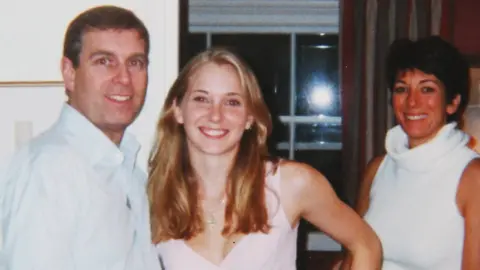
Prominent people, including elites like Prince Andrew, have been confirmed to have been a part of this ring.
Monday brought yet another name into the frame. Emails appearing to originate from Sarah Ferguson, the former Duchess of York and ex-wife of Prince Andrew, revealed a strikingly warm correspondence with Epstein that continued even while he was incarcerated. The closeness of that relationship, documented in what appear to be her own words, raises uncomfortable questions about the social world Epstein had constructed. One in which his crimes seemed to create no meaningful distance between himself and those at the highest levels of society.
What is becoming undeniable, as the days accumulate and the documents pile up, is that Epstein’s network was not peripheral to power. It was woven through it. The files released so far represent only the beginning of what investigators, journalists, and victims’ advocates are working to understand, and the full picture, whatever it turns out to be, is clearly far from complete.
In one email, Ferguson reportedly refers to Epstein as “the brother she always wished for.” It is important to note that the emails do not indicate any wrongdoing on her part. But they do illustrate, with uncomfortable clarity, just how deeply embedded Epstein was within circles that should, by any measure, have known better.
By Tuesday, the 3rd of February, the investigation had taken a sharper legal turn. The Metropolitan Police formally launched an investigation into Peter Mandelson after documents suggested he had been passing market-sensitive material to Epstein during his tenure as Business Secretary in Gordon Brown’s government, right in the middle of the 2008 financial crisis. The implications, if proven, would be seismic. Mandelson has maintained that he did not act criminally and did not act for personal gain. But with police now formally involved, the weight of that denial is being tested in a very different arena than the court of public opinion.
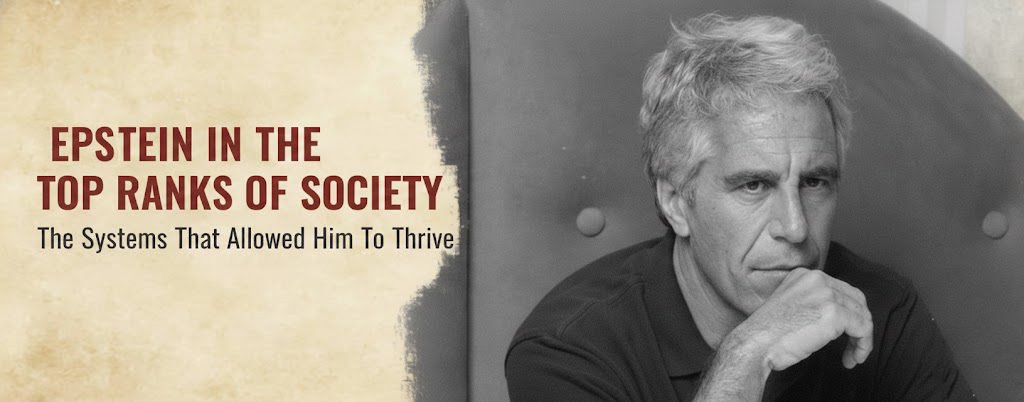
Epstein in the top rungs of society
Epstein’s reach, it is becoming clear, was not contained to any one country or continent. His connections stretched from Norway to Poland to Australia, threading through the upper echelons of global finance, politics, and technology. Among the most prominent names to surface last week was Bill Gates. On Wednesday, the Microsoft founder stated publicly that he regretted “every minute” he spent with Jeffrey Epstein. The documents went further still; Epstein allegedly accused Gates of contracting a sexually transmitted infection from Russian girls, a claim Gates has flatly denied. The relationship between the two men has long been a source of scrutiny, and these latest disclosures have done nothing to quiet it.
By Thursday, the political pressure had reached Downing Street itself. Prime Minister Keir Starmer found himself facing intense scrutiny over his decision to appoint Mandelson as US Ambassador. Starmer faced the media directly and issued an apology; a remarkable moment that underscored just how far the shockwaves from this document release had traveled up the chain of political authority.
But beneath the headlines, the power plays, and the familiar names of the powerful and the connected, there is something far more important that risks being lost in the noise. Then we have the survivors, the people who were exploited, abused, and in many cases, silenced for years while the world looked the other way.
Investigative correspondent Nomia Iqbal, who has been following this case for several years, captured the complexity of what survivors are experiencing right now. “This isn’t just one abuser or one crime,” she explained. “Epstein was at the center of it, but his web spanned governments, royalty, finance, and intelligence-linked circles in the US and the UK — years of institutional failure.”
She was careful to draw a distinction between those analyzing the documents and those living with what they contain. “We are going through these documents one by one as journalists. We’re analyzing. We’re verifying. But for survivors, this is their life. This is a case of reopening their trauma, their abuse. And in many cases, they’re discovering aspects of their abuse that they didn’t know.”
One of the most disturbing revelations to emerge this week concerns not the perpetrators, but the victims themselves. The Department of Justice, in what lawyers have described as causing “irreparable harm,” accidentally released identifying information about survivors who had explicitly requested anonymity. People who had fought — often for years — to keep their identities protected now find themselves exposed. The damage, according to legal representatives, cannot be undone.
Among those who have chosen to speak publicly is Marina Lassera, originally from Brazil and now living in the United States. She was fourteen years old when she first encountered Jeffrey Epstein. He went on to exploit her for three years. Her story is not an outlier in these documents. It is, devastatingly, one of many, and the full account of what was done, to whom, and who knew about it, is still being uncovered.
Marina Lassera’s words, when she finally saw what those files contained, were not those of someone seeking headlines. They were the words of someone in genuine pain. “When I saw my files,” she said, “I was in shock because there are things in there that I did not know, and I had to find out on that Friday when it was released. And it has drained me because I cannot stop thinking about it. I’m just heartbroken about this. I’m extremely, extremely stressed. I’m frustrated. I’m sad. I’m feeling every emotion, and they are not good.” She was fourteen years old when Epstein first entered her life. She is still, decades later, being forced to learn new things about what was done to her.

Marina Lassera in an interview, speaking out.
Ashley Rubbrite was introduced to Epstein sometime after she turned fifteen. She has become one of the more vocal survivors in the wake of the document release, and her words cut through the noise of the political fallout with a precision that no official statement has managed to match. “We didn’t choose this fight,” she said. “We would have much rather just been moms, or gone after our careers, and him just be a distant memory. But we weren’t able to heal in peace. So now we’re screaming in public because we don’t have a choice anymore.” There is no ambiguity in that statement. These are women who were failed by every institution that should have protected them, and who have been fighting ever since, not for fame or settlements, but simply to be believed.
Then there is the story of Virginia Giuffre, one of the most prominent accusers of both Epstein and the former Prince Andrew. She was the young woman in the now-infamous photograph, in which Prince Andrew, then the Duke of York, is seen with his arm around her. Andrew had previously questioned whether the photograph was even real, claiming it had been doctored and denying he had ever met Epstein. That position became significantly harder to maintain this week, after Ghislaine Maxwell, convicted in 2021 as Epstein’s co-conspirator, and also present in that photograph, appeared to confirm that the image is authentic.
Virginia Giuffre died by suicide in April 2025. She did not live to see this moment.
Her sister-in-law, Amanda Roberts, spoke with visible emotion about what this week has meant in the context of Virginia’s life and death. “I felt a moment of such overwhelming emotion,” Roberts said, “because I wish that she were here to see this. She fought so hard and so long, against all odds, and she was still just so strong; not just for herself, but for her survivor sisters and every single survivor who has been discounted.” Roberts paused before continuing: “This is a bittersweet moment. We’re proud of her and her accomplishments. And finally, I think the world is really beginning to see the truth. We’re proud of her, but we miss her greatly in this moment — because she should be here. She should be rejoicing.”
She should be here. That sentence sits at the center of everything. The documents are being analyzed. The powerful are being questioned. Investigations are multiplying across ten countries. But for the women who lived through what these files describe, justice, if it comes at all, has already arrived too late for at least one of those who fought hardest to make it happen.
The survivors are not celebrating. As Amanda Roberts made clear, the release of documents is not the same thing as justice. And the institutional landscape surrounding this scandal makes that distinction painfully apparent.
The only body currently conducting a formal investigation is Congress, but it does not have charging powers. What it does have, however, is the ability to compel testimony. Ghislaine Maxwell, the only person to have been convicted in connection with Epstein’s network, currently serving a 20-year sentence, is due to give a deposition to Congress next week. For survivors, that prospect is not a comfort. It is, in many cases, another source of dread. They wanted these files released, yes. But what they want far more urgently is accountability. Arrests. Charges. Convictions. People in prison. The files, as one more batch lands and another is promised, do not deliver any of that. For the survivors, as Roberts made clear, this is simply not a closed chapter.
The political dimension of the document release is inseparable from the scandal itself, and nowhere is that more visible than in Washington. Donald Trump resisted releasing these files for a year before ultimately relenting. He has since suggested the country should move on, a framing that has drawn considerable fury from those who have spent years fighting for exactly this disclosure.
The reaction across the United States has been, in a word, horror. People are still working through the 3 million-plus documents, still surfacing photographs, still finding identifying information about survivors buried within the files. The Department of Justice, in a detail that raises serious questions about institutional competence or intent, reportedly knew in advance that erroneous releases of sensitive information were likely. They had set up a dedicated email address beforehand for people to contact them to have material taken down. They were aware it was coming. Their stated justification was that they were operating under a deadline. Their position now is that their review is complete, their work is done, and that there are no grounds to prosecute anyone, anyone at all, beyond Epstein himself, who died in custody in 2019, and Maxwell, who is already behind bars.
No other prosecutions are currently being pursued. That conclusion, sitting alongside 3 million pages of documents, is one that survivors and their advocates find almost impossible to process. The question being asked, loudly, and with increasing anger, is how there can be this much material, this much circumstantial evidence, this many names, this many connections, and yet no further accountability. We know the FBI was investigating co-conspirators. We do not know who those individuals are, how thoroughly they were examined, or what reasoning, legal, political, or otherwise, may have led to decisions not to prosecute. Those gaps, in a case of this magnitude, are not footnotes. They are the story.
Congress, the only institution with any investigative reach into this scandal, is Republican-led, and it is moving. Maxwell’s deposition is scheduled for next week. But the appearance that could define the political moment comes at the end of the month, when Bill and Hillary Clinton are due to give evidence before the committee. They refused for months. It took the threat of contempt proceedings and the very real possibility of jail to change their position. They have indicated they want to testify publicly. Whether that is permitted remains to be seen, but if it happens, it will ensure this story dominates the news cycle for weeks to come.
There is also the question of what has not been released. Significant material remains withheld, and the pressure from members of Congress on both sides of the aisle to make it public is growing. What little has been described of the unreleased material is deeply disturbing. According to the Deputy Assistant Attorney General, some of it constitutes child pornography. Some of it, reportedly, contains images of death. Other withheld material is described as personal or medical in nature.
Beyond that, the descriptions become vague — and the vagueness itself is fuelling suspicion. Additional documents held in New York may yet surface. Significant redactions in already-published material remain unexplained. The question of what is being kept back, and why, is one that no official statement has satisfactorily answered.
The Implications of Epstein Files Across the World
If the fallout in Washington has been damaging, the political earthquake in Westminster has been nothing short of seismic. The contrast between the two countries’ responses could hardly be sharper. In the United States, the Department of Justice has declared its review complete and walked away. In the United Kingdom, the Epstein files have pushed a sitting prime minister to the edge.
The documents have revealed not merely that Peter Mandelson knew Epstein, but the nature and depth of what passed between them. According to material now in the public domain, Mandelson appears to have shared sensitive UK government information with Epstein during his time as Business Secretary, including discussions of asset sales within the British government and details of a potential Eurozone bailout in the aftermath of the 2008 financial crisis. That is not a social indiscretion. If accurate, it is a matter of national security.
The consequences have been swift and brutal. Mandelson has been removed from his post as US Ambassador. He has been expelled from the House of Lords. He is no longer a member of the Labour Party, an institution he helped reshape over three decades. A Metropolitan Police investigation is underway. And Parliament has voted to publish all information the UK government holds relating to the vetting process for his ambassadorial appointment, along with all communications between Mandelson, government ministers, and special advisers during his time in the role.
That last point carries enormous implications. A parliamentary committee will decide whether certain material must be withheld on grounds of national security or international relations, a process that is proving controversial in its own right. But a significant volume of information is expected to be made public, and much of it is anticipated to be deeply problematic for Downing Street. Number 10’s current position is that the documents will show that Mandelson lied during his vetting. Mandelson, for his part, insists his answers were accurate.
There is also the question of judgment; specifically, the Prime Minister’s judgment in appointing Mandelson to one of the most sensitive diplomatic posts available. It is, as political correspondent Nick Erdley put it plainly, “no exaggeration to say that the publication of these files could potentially bring down a prime minister.” None of this crisis, not the police investigation, not the parliamentary votes, not the questions over Number 10’s future would have been triggered without that initial release of documents in the United States. One tranche of files, 3 million pages, and the ripple effects are still expanding in every direction.
Keir Starmer remains in his job as of this afternoon. But within his own party, the confidence is quietly draining. A growing number of Labour MPs are no longer certain how long that will remain the case — and the documents keep coming.
While Westminster grapples with its political survival, Windsor faces a different kind of reckoning, one that is less about policy and more about character, proximity, and what exactly was happening behind closed doors.
It has been, by any measure, a devastating week for the Royal Family. Among the most disturbing new details to emerge: a photograph of Prince Andrew, Andrew Mountbatten-Windsor, barefoot and casually dressed, crouching over a woman lying on the ground, believed to have been taken inside Epstein’s Manhattan home. The context is unclear. What is not unclear is the damage.
Separately, emails have surfaced appearing to show Sarah Ferguson, Andrew’s ex-wife, arranging to take her daughters to meet Epstein in the week immediately following his release from prison in 2009. That detail alone has stopped many people cold.

Prince Andrew and Epstein walking together in an undated photo
Senior royal correspondent Daniela Ralph, who has spent the week working through the email exchanges, described what the documents reveal about the nature of the relationships involved. “What has become crystal clear,” she said, “is that the relationship between Jeffrey Epstein, Andrew Mountbatten-Windsor, and Sarah Ferguson was very close.” But beyond the closeness, she noted something more revealing still, the power dynamic running through the correspondence. “When you read the exchanges, his replies to them are quite curt, quite factual. But their responses to him are almost over-complimentary. They’re fawning. They’re even desperate at times in tone.” Epstein, in other words, held the power. A former prince and a former duchess were, in the language of these emails, seeking his approval.
Ralph was unambiguous about the cumulative weight of what has emerged. “That photo,” she said, “really marks the start of the downfall of Andrew Mountbatten-Windsor.” The files released this week have not softened that assessment. They have hardened it.
The pressure on Andrew Mountbatten-Windsor to cooperate with US authorities has been building for years, and these documents have only intensified it. Various avenues have been pursued, various approaches made, all of them, to date, unsuccessful. Andrew has not spoken. He has not cooperated. And the Palace, for its part, has maintained a conspicuous public silence throughout the week. King Charles and Queen Camilla were out in public, and questions were shouted at them, but nothing came back.
The only member of the Royal Family to say anything at all was Prince Edward, Andrew’s younger brother, who was asked about the situation at a conference in Dubai. His response was brief: his thoughts, he said, were with the victims. “There are a lot of victims in this situation,” he noted, a statement that was true, and carefully non-committal about the brother he did not name.
Sources within the royal household have been equally careful. Their position, passed quietly to correspondents, is that whether Andrew ultimately gives evidence to the authorities comes down to one thing: his conscience. That answer will satisfy very few people. Least of all the survivors.
The British Royal Family is not alone in facing uncomfortable scrutiny from these files. Crown Princess Mette-Marit of Norway appears hundreds of times in the latest release. She has expressed deep regret for a friendship with Epstein that, the documents make clear, continued even after his 2008 conviction. Her willingness to acknowledge the relationship publicly stands in contrast to the silence emanating from Windsor, though the documents raise their own serious questions about judgment and proximity.
Beyond royalty, the files read like a directory of the global elite. Business editor Simon Jack, who has spent the week working through the financial and corporate dimensions of the network, was direct about its scale. “If you are extremely rich and powerful, there’s every chance you will be mentioned in these files,” he said, adding the important caveat that appearing in the documents does not in itself imply wrongdoing. The names, however, are extraordinary in their reach: Elon Musk, Richard Branson, Bill Gates, Leon Black, Sergey Brin, Larry Summers, and Mohamed bin Salman, a constellation of wealth, influence, and access that Epstein appears to have cultivated with deliberate precision.
Some of those names have already paid a professional price. Jes Staley, the former Barclays CEO, and Leon Black, founder of private equity giant Apollo, both stepped down from their respective roles because of their associations with Epstein, without admitting any wrongdoing. Ben Wegg-Prosser, who co-founded a PR company with Peter Mandelson, stepped down from his own business just a year ago. Richard Branson acknowledged visiting Epstein on a small number of occasions over a decade ago, describing the relationship as limited to group business settings and saying he regretted it. Elon Musk’s name appears in connection with an inquiry about attending a party, one he says he never went to. Bill Gates’s history with Epstein stretches back years and has been the subject of sustained scrutiny.
The current Governor of the Bank of England, Andrew Bailey, reacted with visible emotion when the details were put to him. “I don’t want to sound pious,” he said, “but this is, this is for all of us.” It was an unusually raw moment from one of Britain’s most senior financial officials, a man not given to public displays of feeling. That he felt moved to say anything at all tells its own story about what is in those pages.
Andrew Bailey’s words, “How is it that we live in a society in which this has happened, and the cover-up happened as well?”, capture something that no official statement has yet been able to adequately address. The Governor of the Bank of England was not speaking in his capacity as a regulator. He was speaking as someone genuinely shaken by what the documents reveal about the world in which he operates.
The legal questions arising from the Mandelson material are being examined carefully. Investigators are looking at whether the leaking of market-sensitive information constitutes misconduct in a public office; a serious charge that carries significant consequences if proven. The question of insider trading has also been raised publicly. The legal definition is narrow: to prove it, prosecutors would need to demonstrate that specific trades were made on the basis of the information passed. That is a high evidentiary bar. But the broader question, of whether people in Epstein’s circle used what they were given to gain financial advantage, remains very much open.
Simon Jack, who has spent decades covering global business and finance, was asked directly whether he had ever seen anything like this. His answer was unambiguous. “No. I’ve never seen anything quite like this, with so many tendrils reaching out to so many people. It’s not just in the US business. It’s a UK business. Mohamed bin Salman is in this correspondence. There are families in France. There are people in Norway.” He paused on the central irony of it all. “It’s actually amazing how a sort of lawyer from Brooklyn managed to construct this web. The idea was to confer a bit of advantage and favor, and it ended up being very corrosive for all concerned.”
Understanding the full scope of what is in these documents requires not just reading them, but verifying them — and that work is far from complete. Investigative teams have been deploying data scientists to write code that can identify files of interest within the vast archive. Close to a thousand videos have been assessed. Photographs have been geolocated. And the challenges have been considerable: many videos came with no metadata whatsoever, no date, no location, no contextual information. In some cases, the language used in reporting has had to be chosen with particular precision, with journalists describing “young females” in footage because it was not possible to confirm whether those individuals were girls or young women.
The Department of Justice’s redaction failures have created an additional and deeply serious problem. Some of the photos and videos in the released files contain images of survivors who did not consent to being identified — and while the DOJ has taken some of that material offline, not all of it has been removed. The damage, as lawyers representing those survivors have made clear, cannot be fully undone.
There is also a disinformation dimension to this story that demands attention. Fake documents are circulating at scale. Fabricated emails purporting to be from Elon Musk. Fake images claiming to show figures including New York Mayor Eric Adams. Some of this material has accumulated millions of views. None of it comes from the actual document release — but in the current information environment, that distinction is not always being made clearly enough.
What comes next is, in many ways, the most consequential question of all — and the answer is that nobody fully knows.
More revelations from the existing batch of documents are certain. Journalists and investigators have been working through the files for a week, and given the sheer volume of material, significant details are still being surfaced daily. But beyond what has already been released, further files are known to exist. The Trump administration’s position on how many will ultimately be made public has shifted more than once. At one point, there appeared to be little commitment to any significant release at all. Pressure from within Trump’s own support base contributed to the change in posture. How much further that posture will shift remains genuinely unclear.
In Westminster, the transparency cascade triggered by the US release is only beginning. Senior UK government figures may be required to disclose electronic communications — emails and messages exchanged with Peter Mandelson. That disclosure could run to as many as 100,000 documents. The implications stretch well beyond the Mandelson affair itself. Those communications may offer a window into how the UK government perceives its relationship with the United States, and potentially how some British officials privately view Donald Trump. For Number 10, that prospect is not an abstract concern. It is an immediate and very personal one.
Anyone who sent those messages will be asking themselves the same question right now: will what I wrote end up in the public domain? In a week that has already destroyed careers, triggered police investigations, destabilised a government, and reopened the wounds of survivors who have waited years for any semblance of accountability — that question has no comfortable answer.
The story is not over. It is, in several important respects, just beginning.
Read more documents on conspiracy theories, and darkhistory as well.